

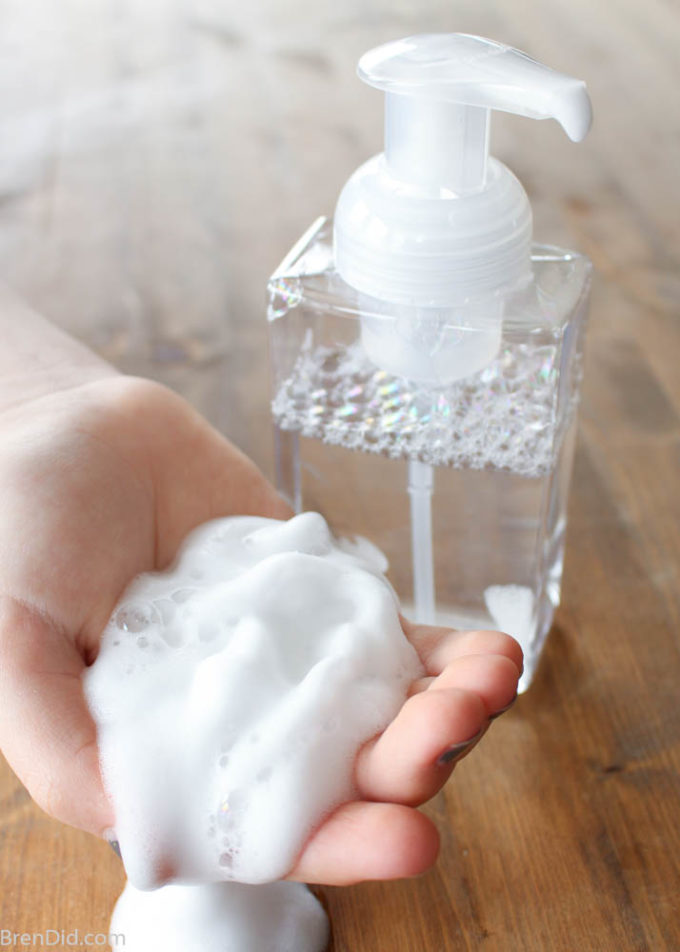
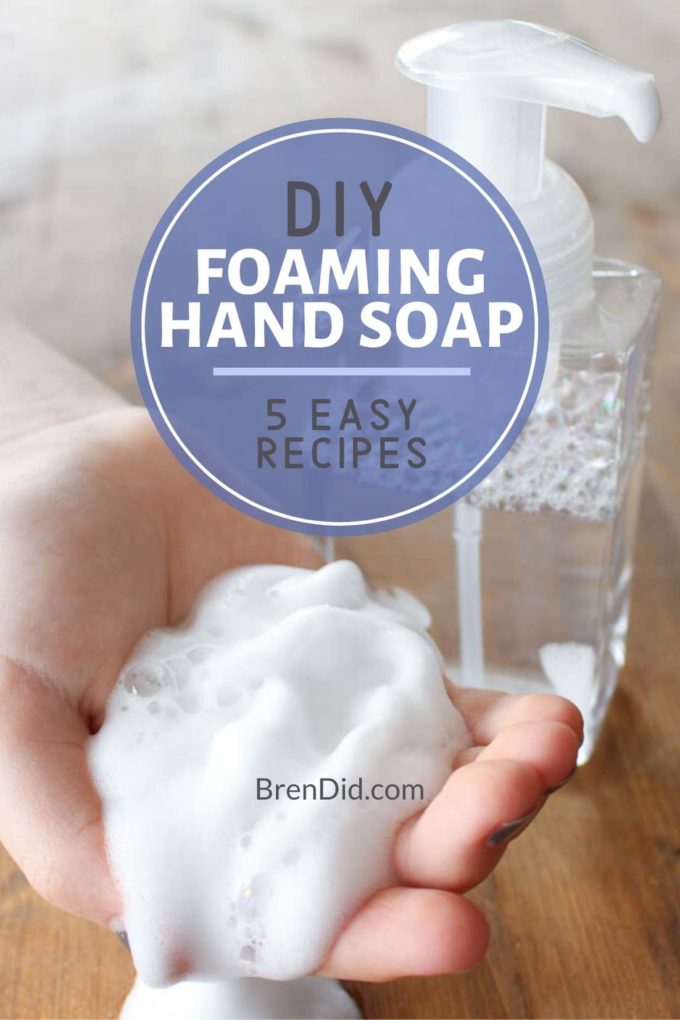
Learn to make easy all-natural foaming hand soap in five different ways. It’s the easiest non-toxic DIY you’ll ever attempt. To make foaming hand soap you need just two simple ingredients: 1. liquid soap or detergent and 2. water. Combine the two in an empty foaming hand soap container and you’ll never run out of foaming hand soap again!
This post uses affiliate links. They don’t cost you a thing and help us bring you creative projects. Read more in Policies & Disclosures.
This easy guide to DIY homemade foaming hand soap will teach you to make foaming hand soap from soap, detergent, body wash, or even shampoo. Plus learn how and when to add additional ingredients to moisturize hands and add scent.
Can You Love Soap?
Cause I love foaming hand soap! It is an easy to use, convenient product that doesn’t leave globs of liquid soap all over the sink… and I love any product that results in less time cleaning bathrooms!
Plus foaming hand soap is easier on the environment and more cost-effective than regular liquid soap. Except…
The Downside to Foaming Hand Soap
There is also a lot DISLIKE about most foaming hand soaps:
- Dangerous ingredients – Many store-bought versions contain unhealthy ingredients such as artificial fragrance, artificial color, triclosan, and a host of other additives that can act as allergens, endocrine disruptors, or carcinogens. These substances may cause allergies to develop in young children, early-onset puberty, and/or cellular level changes. My love of bubbles is not worth a malfunctioning immune system or breast cancer!
- Cost – Another problem with foaming hand soap is the cost! An all-natural, non-toxic version of foaming hand soap can cost more than $5 for an 8-ounce bottle that contains mostly water.
- Plastic waste – Foaming hand soap is often sold in single-use plastic bottles. I don’t like adding to the amount of plastic waste produced in the world, but the bottles can be used again and again by buying a refill bag or making your own soap solution.
Luckily all-natural foaming hand soap is the easiest non-DIY project you’ll ever attempt!
To make foaming hand soap you need just two simple ingredients: 1. liquid soap or detergent and 2. Water. Combine the two in an empty foaming hand soap container and PREST… foaming hand soap!
DIY Foaming Hand Soap Ingredients
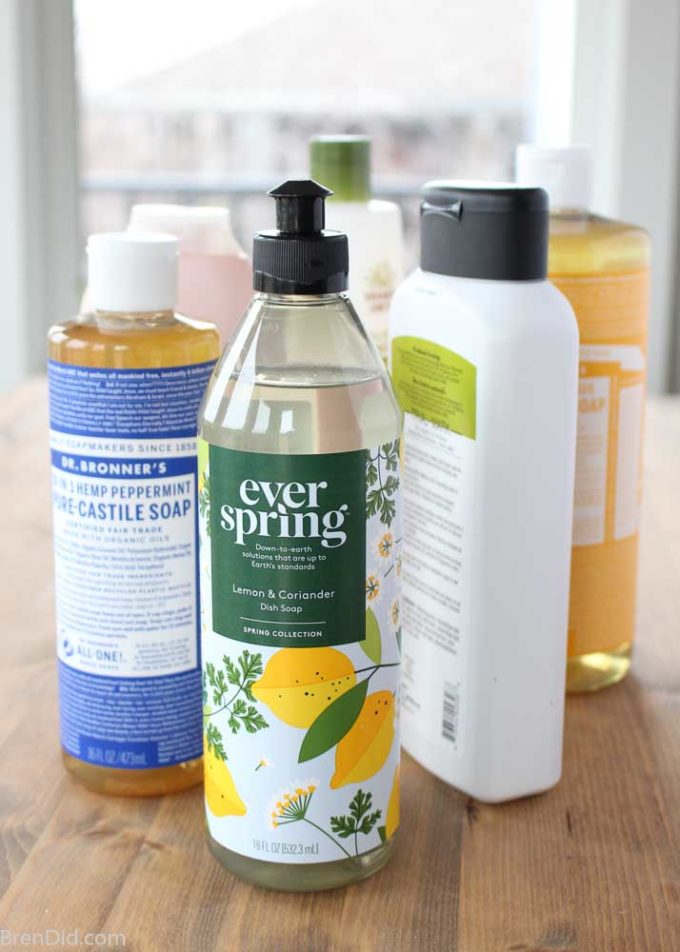
Foaming hand soap can be made from any liquid soap or detergent found in your home. It just needs to be diluted with water! Of course, different detergents/liquid soaps will clean your hands in different ways so you might have to try a few versions before you find one you love.
1. Liquid Soap or Detergent
The first necessary ingredient in foaming hand soap is liquid soap or detergent. In the US we call commonly call all hand washes “soap” the same way we call all facial tissues “Kleenex.” In reality, some hand washes contain soap and some contain detergent. Both soap and detergent will work in this recipe because both remove soils and bacteria when aided by friction and water.
- Common soap examples: Liquid Castile soap, a liquid vegetable oil soap that can be used in homemade foaming soap recipes.
- Common detergent examples: liquid hand wash, body wash, liquid dish detergent (for hand washing dishes), and shampoo are all detergents that can be used in foaming hand soap recipes.
- Note: Select a natural soap or detergent if you want to make all-natural foaming hand soap. Any liquid soap or detergent will work in this recipe but some contain better ingredients.
2. Water
The second necessary ingredient in foaming hand soap is water. In fact, water is what turns liquid soap into foaming hand soap!
- Use distilled, filtered, or boiled (then cooled) water to make sure there is no bacteria present. Your foaming hand soap will last longer, and you’ll be sure your hands are getting clean.
Optional Foaming Hand Soap Ingredients
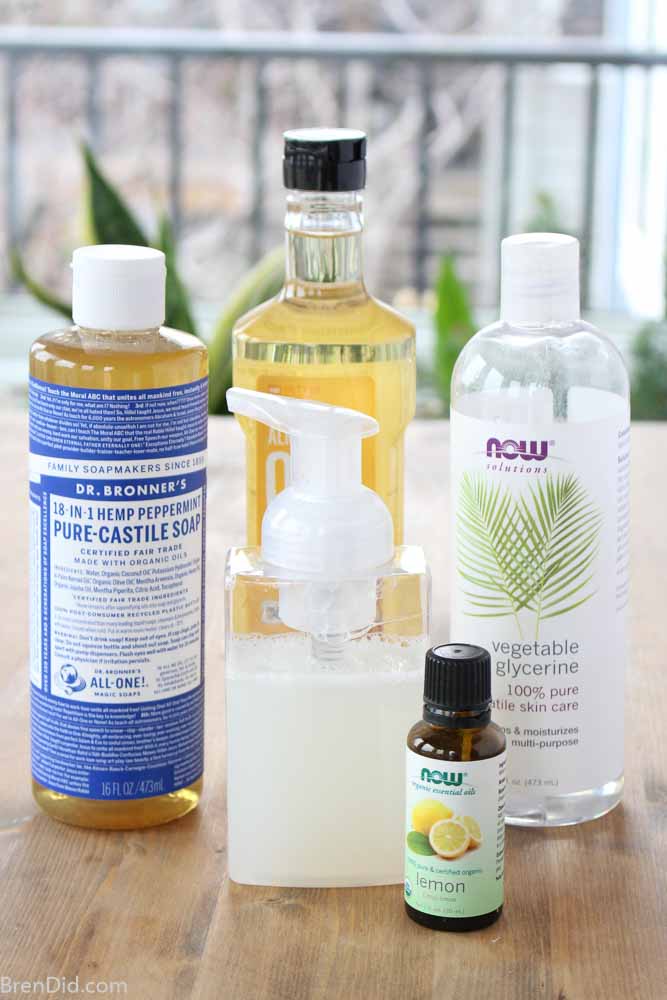
You can customize your foaming hand soap by adding one or more of these 3 optional ingredients:
1. Moisturizing Oil
Moisturizing oils are sometimes used in foaming hand soap recipes to soften the skin since soap and/or detergent can be drying. Especially when hands are washed frequently.
- How to add moisturizing oils to foaming hand soap: If you’d like to add oil to your soap start with one teaspoon of argan oil jojoba oil, avocado oil, sweet almond oil, fractionated coconut oil, etc.
- A note on moisturizing oils: You may find that adding moisturizing oil decreases the cleaning power of your soap. You can skip this ingredient and simply rub a drop or two of the oil into your hands once you are done washing.
2. Essential Oils
Essential oils (EOS) are sometimes used in DIY foaming hand soap recipes to add scent and/or to increase the antibacterial power of the soap (some essential oils have been shown to have antifungal/ antibacterial properties).
- How to add essential oils to foaming hand soap: If you’d like to add oil to your soap start with one teaspoon of moisturizing oil and add 1-15 drops of essential oils. Follow this chart for proper dilution by oil type.
- Notes on essential oils: The addition of EOS is completely optional and does not change the effectiveness of the foaming hand soap. Science shows that proper handwashing with plain soap and water is just as effective at preventing illness.
- If you are adding EOS to your foaming hand soap you must dilute them with a carrier oil first. Essential oils are not water-soluble so you cannot simply add them to a solution of water and soap. This rule applies to ALL brands of EOS.
- EOS can cause adverse reactions in children, adults, and pets including allergic reactions, skin irritation or rash, and neurological impartment. Health experts recommend limiting the use of many EOS on surfaces that contact food and in homes with sensitive individuals (children under 5, pregnant women, people with respiratory issues, and certain pets).
3. Vegetable Glycerin
Vegetable glycerin is sometimes used in all-natural foaming hand soap recipes to help moisturize the skin, soothe skin irritation, and/or thicken the final product.
- How to add glycerin to foaming hand soap: If you’d like to add glycerin to your soap start with 1 tablespoon of vegetable glycerin.
- A note on glycerin: You may find that adding glycerin leaves hands feeling a bit sticky. You can skip this ingredient and moisturize your hands once you are done washing.
How to Make Foaming Hand Soap with Castile Soap
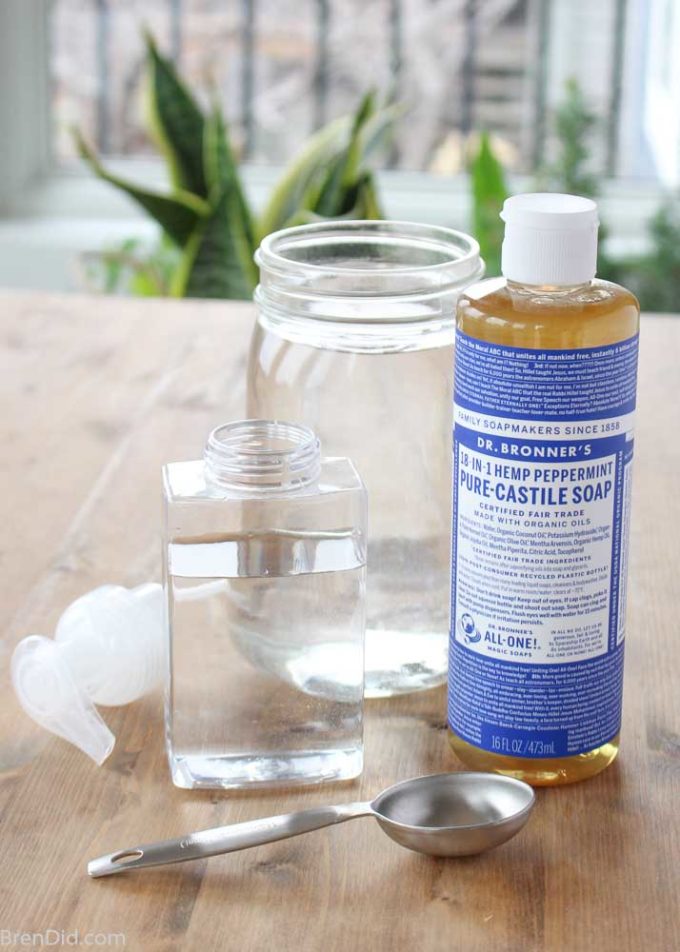
Supplies
- 2 Tbsp. Liquid Castile soap (1 fluid ounce)
- 3/4 C. Water (6 fluid ounces)
- Foaming hand soap dispenser (or reuse an old dispenser)
Directions
- Add liquid Castile soap to foaming hand soap pump.
- Add 6 ounces of water to the container (make sure you leave room for the pump or the bottle will overflow).
- Stir or swirl gently to combine.
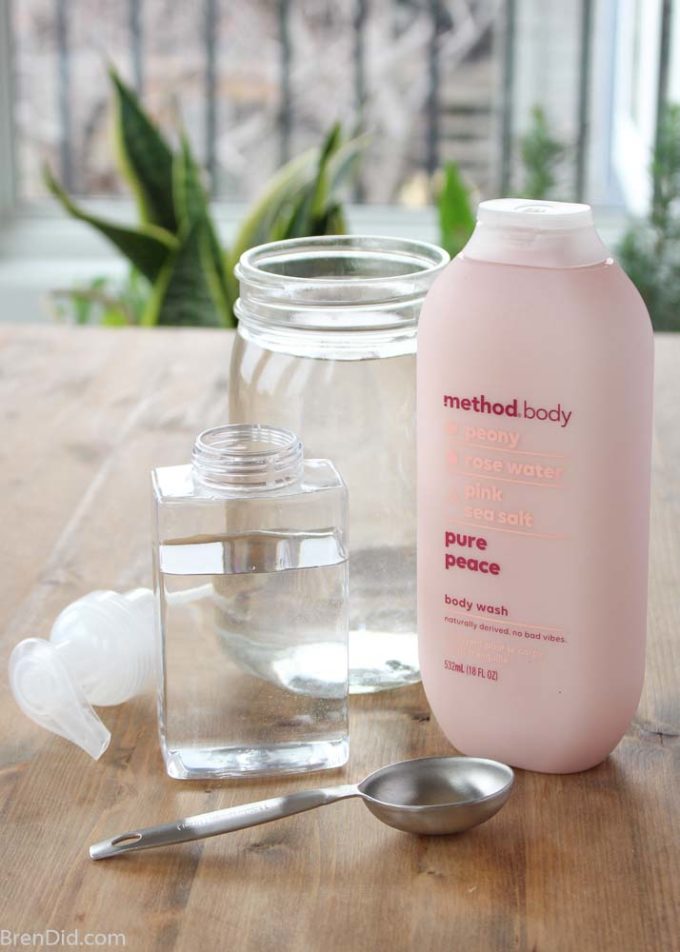
How to Make Foaming Hand Soap with Body Wash
Supplies
- 1 Tbsp. Liquid Body Wash (0.5 fluid ounce)
- 3/4 C. Water (6 fluid ounces)
- Foaming hand soap dispenser (or reuse an old dispenser)
Directions
- Add liquid body wash to foaming hand soap pump.
- Add 6 ounces of water to the container (make sure you leave room for the pump or the bottle will overflow).
- Stir or swirl gently to combine.
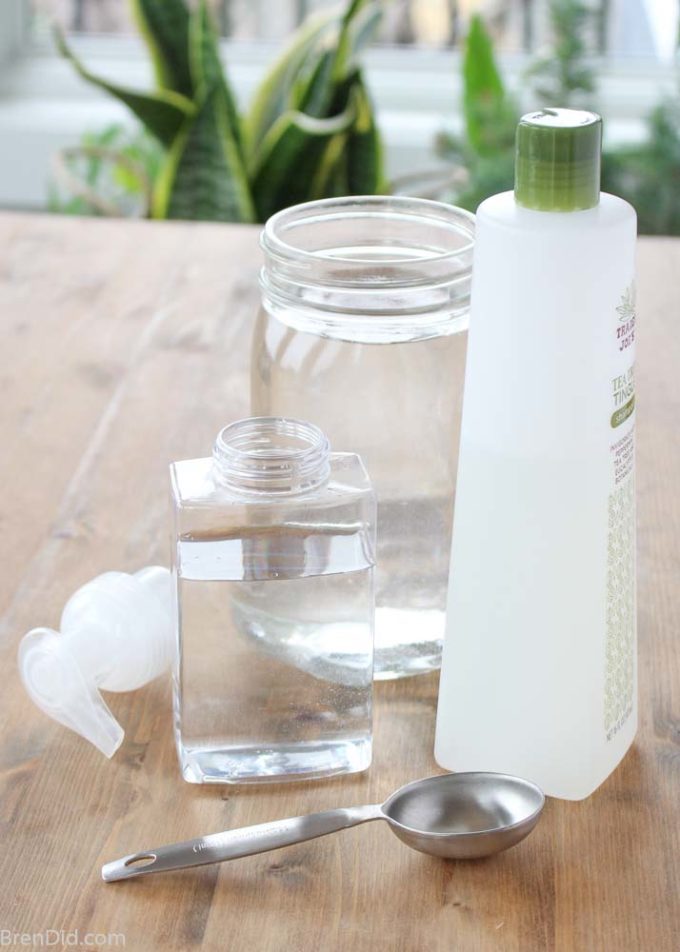
How to Make Foaming Hand Soap with Shampoo
Supplies
- 1 Tbsp. Shampoo (0.5 fluid ounce) – pick a simple shampoo not one that is medicated or color depositing
- 3/4 C. Water (6 fluid ounces)
- Foaming hand soap dispenser (or reuse an old dispenser)
Directions
- Add liquid Castile soap to foaming hand soap pump.
- Add 6 ounces of water to the container (make sure you leave room for the pump or the bottle will overflow).
- Stir or swirl gently to combine.
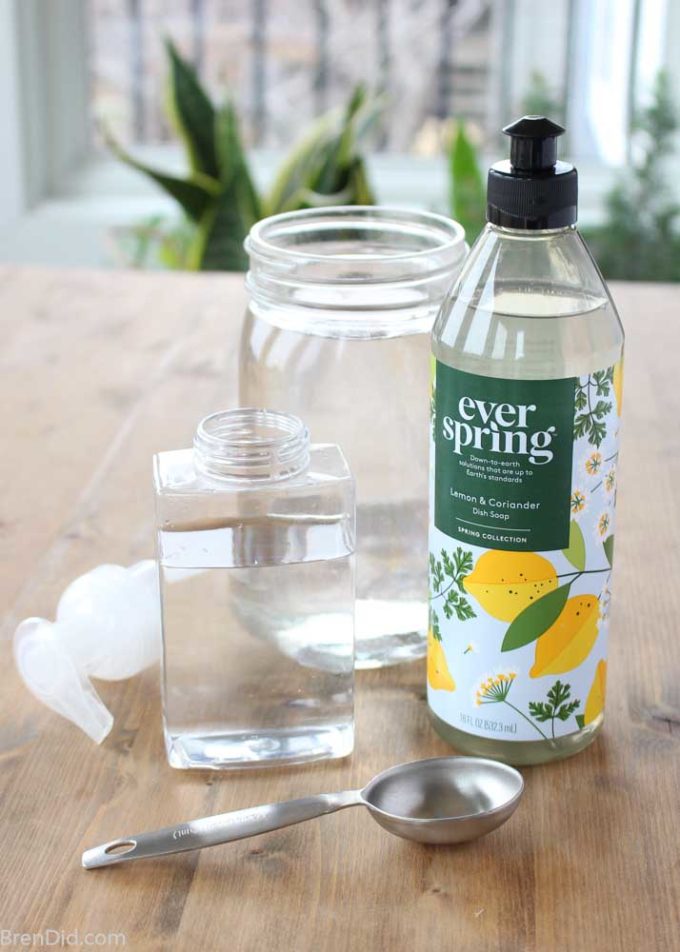
How to Make Foaming Hand Soap with Dish Detergent
Supplies
- 2 Tbsp. Natural Dish Detergent (1 fluid ounce) – the kind used for hand washing dishes in the sink
- 3/4 C. Water (6 fluid ounces)
- Foaming hand soap dispenser (or reuse an old dispenser)
Directions
- Add liquid Castile soap to foaming hand soap pump.
- Add 6 ounces of water to the container (make sure you leave room for the pump or the bottle will overflow).
- Stir or swirl gently to combine.
How to Make Foaming Hand Soap with Hand Soap
Supplies
- 2 Tbsp. Liquid Hand Soap (1 fluid ounce)
- 3/4 C. Water (6 fluid ounces)
- Foaming hand soap dispenser (or reuse an old dispenser)
Directions
- Add liquid Castile soap to foaming hand soap pump.
- Add 6 ounces of water to the container (make sure you leave room for the pump or the bottle will overflow).
- Stir or swirl gently to combine.
How Foaming Soap Works
All foaming hand soaps contain one active cleaning ingredient: soap or detergents. Both soap and detergents are surfactants: they lower the surface tension of water which makes it more able to bind with soils and oils.
Both detergents and soap molecules have a hydrophobic end that binds to the soil and a hydrophilic portion that binds to water, so when you rinse your hands, the soap or detergent is swept away by the water and it carries unwanted soils away with it.
Why does foaming soap foam?
Foaming hand soap is simply liquid soap or detergent diluted with water. As the mixture leaves the dispenser it is mixed with air to create a foamy lather.
You must use a foaming hand soap dispenser for foaming hand soap to work properly. When the diluted soap is placed in a regular soap dispenser you will simply get watery soap.
Foaming Hand Soap Q &A
What is Castile soap? Castile soap is vegetable oil-based soap that can be found in both bar and liquid forms. The name Castile comes from the region of Spain where this technique of soap making originated. Today Castile soap is made all over the world, often from coconut oil or olive oil.
How is Castile soap different from other soaps? In the United States, many soaps are made from animal fat. When you see the ingredient sodium tallowate or tallow acid on a soap label you know the soap is made from animal fat.
How can I make naturally scented hand foaming soap? There are two easy ways to scent your soap:
- Buy scented Castile soap, it comes in a variety of scents including peppermint, lemongrass, pine, lavender, citrus, almond, eucalyptus, rose, tea tree, and orange. You can even combine scents to make your own blends.
- Add a few drops of essential oil along in a carrier oil to your soap and water mixture. Please use caution when adding essential oils to foaming hand soap. Essential oils are not water-soluble and can separate from the mixture as it sits in your bathroom. These undiluted oils can damage the skin or cause an allergic reaction if they are dispensed onto bare hands.
How can I make moisturizing foaming hand soap? There are two easy ways to make moisturizing soap:
- Buy liquid Castile soap that contains shea butter. It also comes in a variety of scents and is naturally moisturizing.
- Add a teaspoon of moisturizing oil to your soap. Read more in the “Moisturizing oil section” above.
Can I make foaming body wash? Yes, follow the steps for foaming hand soap and put the dispenser in your shower or bathtub. Use plain Castile soap if you want to the foaming soap use it as shampoo, not a moisturizing shea butter version which is hard to rinse out of hair.
Can I use dishwasher detergent to make foaming hand soap? No, foaming hand soap can only be made with dish soap that is formulated for hand washing dishes in the sink. Dishwasher detergent is not meant to come into contact with human skin and does not contain the same lathering ingredients.
Can I use bar soap to make foaming dish soap? Yes. People have successful melted grated soap in hot water and then diluted the mixture to make foaming hand soap. While this works in a pinch, I have found it to be a bit gloppy in the long run.
Foaming Hand Soap Cost
Making your own all-natural foaming hand soap is much cheaper than buying natural foaming hand soap at the store. My favorite store-bought version costs about $3.00 for 8 fluid ounces.
- Liquid Castile soap costs approximately $16.00 for 32 ounces.
- My homemade foaming hand soap uses one ounce of Castile soap plus water to make 6 ounces for $0.50!
That’s a cost savings of more than $2.00 and I can tell NO DIFFERENCE!
Soap and Detergent Buying Tip
Be sure to check your product labels when buying any natural body care product, even Castile Soap. Many products claim to be pure and natural but have synthetic chemicals or fragrances added. I like to check my products on the EWG Consumer Guides or on a Smartphone with the Think Dirty App.
Want to learn more about healthy body care? Sign up for my free weekly newsletter below.


fluf
Hi your amazon link for the foaming soap dispenser no longer works (https://amzn.to/2UyKj5d). What dispenser are you using in the first picture? (the clear plastic container and white pump)
Bren
I like this disenser – https://amzn.to/3rfobgZ – or purchase a bottle of foaming hand soap and reuse the dispenser once it is empty.
Sabrina
Do you have a recipe for regular hand soap? Not foamy?
Bren
I only have a foaming recipe at this time. I find it most economical to buy refill bags or tablets.
Dawn Buzard
Thank you for these great ways to make homemade foaming hand soap! No longer will I need to waste money on something made so easily at home. I’ve already made it with Castile soap and it’s the same as store bought, I cannot tell the difference at all!
Bren
Thanks, Dawn!
Deborah Waterhouse
How long do the soaps last? there doesnt seem to be any preservatives in it..I dont want to use EO
Deb
Bren
I have used the same bottle for several months with no problem when mixed using distilled water.
john
Will the water separate over time when mixed with castille soap? do you constantly have to continue to mix it?
Bren
I have to swirl it around occasionally…. maybe once a week.
Sue
Hi Bren,
Thanks so much for these recipes. Can you add alcohol to create a soap that will kill germs as well?
Bren
No, the alcohol concentration would not be high enough. Vigorous hand washing is the best bet!
Long
Great recipe. I was making my own, but this recipe is so much better. Thank you!
Millie
Does the castille soap (Bronner’s) clog the foaming dispenser? I t does in my regular dispenser.
Bren
I have not had a problem with clogging unless the soap goes unused for several weeks.
Deb Ozeck
in some of the recipes some of the products used call for 1 Tbsp and some call for 2 Tbsp, But they all say 1 ounce. Please clarify that. One ounce equals 2 Tbsp. Is Shampoo more concentrated than regular liquid hand soap, for example?
I like the idea of making my own foaming hand soap for many reasons: I can save money, have less plastic waste and get the scents I want. 🙂
Bren
Sorry for the confusion, Deb! I’ve updated the recipes. 1 tbsp = 0.5 fluid ounce. 2 tbsp = 1 fluid ounce.
Denise Wren
There is a glass dispener that comes up on your site with nozzle and pump button which sits behind nozzle. Where can I purchase such a container. I could send you a picture to make it more clear if you could give me an email address.
Bren
Denise, I think you’re looking for this oil can soap pump (affiliate link)
Karen Reilly
Where did you get the soap dispenser?
Bren
Mine is upcycled from an old bottle of foaming hand soap. I’ve also seen them online here and here for Mason jar lids. Hope this helps!
Shelly L Williams
Do you have a recipe for good DIY shampoo? I thought I read somewhere using coconut milk and Dr Bronner’s but now I can’t find it,
Bren
Sorry, Shelly. I don’t have one.
Sophie
Hi! I have been browsing your website a lot and I love how you explain/test everything! I have a bar of castile soap and I was wondering if i could melt some of it to achieve the same result in any recipe in which you use liquid castile soap? I read an article saying that bar and liquid soap are very different (for various reasons) and hence cannot be used the same, but still? Soap is soap? Thank you!
Bren
I’ve never tried with melted bar Castile soap so I’m not sure how it would work. I do know that liquid Castile soap is less concentrated than solid Castille bars (1 cup of liquid Castile soap equals 3.64 ounces of bar soap). Let me know if you try and it works.
Ged
Liquid and solid soaps are made with different bases (alkalis): solid with sodium hydroxide, liquid with potassium hydroxide. Since that is the only difference between the two it’s obvious that the sodium hydroxide makes a solid soap. if you melt it in water, which is possible, it will tend to re-solidify, become a gel and clog the nozzle of the dispenser. To actually have the soap stay liquid you would have to use so little that it wouldn’t create any foam.
Bren
Thanks for commenting, Ged. I loved learning more about soap making!
Ems
Great Post!
Just FYI: Bronner’s Castille soap contains coconut oil (second ingredient), which is extremely comedogenic…in case someone wants to use this on their face or body but is break out prone. Not a good idea!
Bren
Ems, the second ingredient is actually Saponified Organic Coconut Oil. When making soap the fat (in this case coconut oil) is combined with lye to produce a chemical reaction called saponification. The end result is soap plus glycerin. You can read more about washing your face with Castille soap here.
mel sarver
Sorry. I meant to say foaming soap by using half baby shampoo and half water. It works well as a refull
Bren
Great idea! I’ll have to try it out.
mel sarver
I have made foaming soup by using half baby shampoo and half water. It works well as a refuill
Gigi
What is the life of this soap giving the fact that u are not using any preservative? I have read that people make enough for 2 days or a week.
Bren
It lasts for a long time, it’s just thinned soap. Use distilled water if you are concerned about contaminates.
Jody
Is this anti-bacterial?
Bren
No, I prefer not to use anti-bacterial hand soap.
Emie
I had the same question but am curious why you prefer not to use anti-bacterial? With small kids am wondering if an anti-bacterial is necessary…
Bren
Some bacteria is good for us, it helps kids develop healthy immune systems. Plus using antibacterial products allows resistant bacteria to develop. For these reasons I do not use antibacterial products, just standard cleaners such as soap and water.
Emie
Thank you!
Karen
I agree! I’ve done extensive research on this topic. Short version; Soap is (and always has been) formulated to kill unwanted bacteria and germs that need killing and only that need killing. Antibacterial products are definitely overkill and it’s making us sick. We’ve become hyper sensitive to the norms. This creates the need/abuse of antibiotics. Then we build up a resistance to those. It’s a horrible cycle.
My daughters step-mother is an elementary school teacher. She had introduced my daughter to this vicious cycle. I had a heck of a time finding a cure for her when she had strep throat with an ear infection.
Bren
Thanks for commenting, Karen!
Summer Larrimore
Can you add essential oils to this?
Bren
You can add essential oils, however be aware that EOs are not water soluble so they can seperate and need to be shaken for each use. I prefer to use a scented castile soap to get scent.
Irene
I love Essential Oils. May I add one table spoon of Organic Witch Hazel to mix the oil and water? Would it be okay for the skin?
Bren
If you are using essential oils I would only use a few drops and shake before using. I love EOs too, but they are not water soluble so they can separate.
Kari
I think the person above was asking about adding 1 tbsp of witch hazel to the water and Castile soap mixture to act as an agent to help keep the oils distributed within the water. Much like how you use vodka to distribute oil from lemon rinds or pine needles in your DIY lemon household cleaner.
Bren
I’m uncertain the witch hazel would keep the oils fully suspended, I would mix the essential oils with a carrier oil. I prefer to keep it simple with just the liquid Castile soap and water.
September
Do you have to reswirl the bottle or does it keep?
Bren
September, I occasionally have to swirl the soap in our guest bathroom (it isn’t used often). The rest of the soaps stay mixed.
Jane
Castile soap contains only olive oil, Bastille soap contains olive and coconut oil. Castile soap takes a very long time to come to trace, by adding the coconut oil, trace happens faster.
Castile is also very mild and can be used on very young and old skin.
Bren
You are correct, Jane. Castile soap is all olive oil while Bastile contains olive oil with other vegetable oils. Today many manufacturers (and most non-soap makeing consumers) use the term Castile for both soaps. For example, Kirk’s Castile Liquid Soap is make with coconut oil and Dr Woods Liquid Castile Soap is make with coconut, hemp & olive oils.